

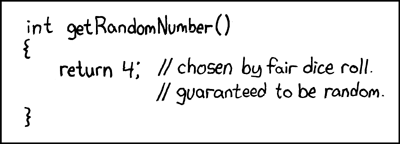
I have always used Random’s nextInt() or nextLong(). So was curious on how “random” is it actually? Then I found this protected method next().
protected int next(int bits)
Implementation of Random.java via Google code:
protected int next(int bits) {
    long oldseed, nextseed;
    AtomicLong seed = this.seed;
    do {
        oldseed = seed.get();
        nextseed = (oldseed * multiplier + addend) & mask;
    } while (!seed.compareAndSet(oldseed, nextseed));
    return (int)(nextseed >>> (48 - bits));
}
The general contract of next is that it returns an int value and if the argument bits is between 1 and 32 (inclusive), then that many low-order bits of the returned value will be (approximately) independently chosen bit values, each of which is (approximately) equally likely to be 0 or 1. The method next is implemented by class Random by atomically updating the seed to:
(seed * 0x5DEECE66DL + 0xBL) & ((1L << 48) - 1)
and returning:
(int)(seed >>> (48 - bits))
This is a linear congruential pseudorandom number generator, as defined by D. H. Lehmer and described by Donald E. Knuth in The Art of Computer Programming, Volume 3: Seminumerical Algorithms, section 3.2.1.
Interesting!
EDIT: Something even more interesting: Why this code is giving strange result? So Random?
Link to JavaDocs for Random.